The games sitting in your library right now were almost certainly built, tested, or balanced with some form of AI in the pipeline. That's not a prediction about where gaming is heading. It's already here. And the shift is bigger than most people realize.
How AI Makes NPCs Actually Difficult
For a long time, enemy AI worked off scripts. Guard patrols looped. Boss attacks telegraphed. Players learned the pattern and the challenge evaporated.
Now, non-player characters adapt. They track your tendencies across a session, respond to what you've done rather than what the developer anticipated you'd do, and scale that response to your actual skill level. A player grinding through their first run gets a different fight than someone with 200 hours logged.
That's not just a quality-of-life feature. It's a fundamental change to what 'difficulty' means in a game.
What AI Does on the Development Side
Developers feel this more than players do, at least right now.
Building a believable open world used to require hundreds of designers placing every rock, tree, and building by hand. Procedural generation, driven by AI, handles much of that now. The result is bigger maps, more content variation, and dev time that gets redirected toward the parts of a game that actually need human creative judgment.
Bug detection and balance testing are changing too. AI can run thousands of simulated playthroughs overnight, surface broken quest flags, and flag weapons that trivialize content. That used to take weeks of QA cycles.
Faster pipelines mean more ambitious games. Not always better games, but the ceiling on scope has risen.
Personalization Is the Part Players Notice Most
Matchmaking is the clearest example. Pairing players by raw win/loss ratio produces lopsided lobbies. AI-driven matchmaking looks at a wider picture: reaction time, decision patterns, preferred playstyle, even recent performance variance. The result is lobbies that feel competitive without feeling punishing.
Outside of multiplayer, single-player games are getting better at pacing themselves to you. Difficulty that adjusts mid-session. Story branches that shift based on choices you made two hours ago. Dialogue that reflects what your character has done rather than defaulting to generic lines.
None of that requires you to touch a settings menu. It just happens.
CLX Insight
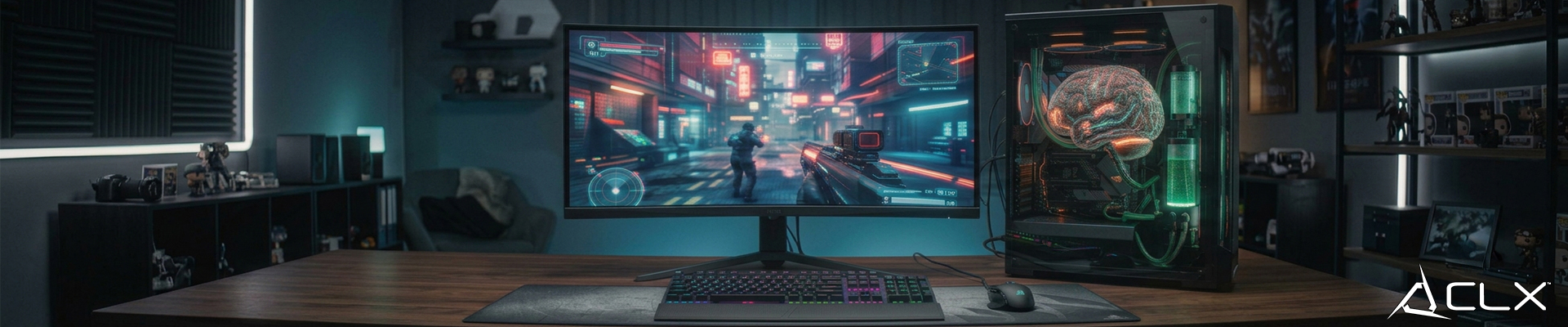
We build machines for people who don't want the hardware getting in the way of any of this. AI-driven game systems, adaptive rendering, real-time upscaling, they're all compute-heavy in ways that weren't true of scripted game logic. When we're configuring a build for someone who games at 1440p or 4K, the headroom in the CPU and GPU matters more than it did three years ago, because the games themselves are asking for more per frame. We've seen that reflected in the builds customers spec out. The gap between 'enough' and 'comfortable headroom' has widened.
The Problems Worth Watching
AI-generated content can feel thin. Endless procedural variation without authorial intent produces maps that are technically different but experientially identical. Getting the balance right between scale and craft is still an unsolved problem.
Privacy is the other one. Adaptive systems learn from player behavior, which means they collect it. How that data is stored and used varies by studio and platform. It's worth paying attention to.
And on the fairness side: AI that reads your habits too well can start to feel less like a challenge and more like a system designed to frustrate you just past your threshold. That line between engaging and annoying is hard to calibrate.
Gaming Will Keep Moving Fast
Studios investing in AI tooling are shipping more content with smaller teams. Players are getting experiences that respond to them rather than expecting them to adapt to fixed systems. The gap between those two things is closing.
That puts pressure on the hardware side of the equation, and that's where we come in.
If you're building or upgrading for games coming out in the next two to three years, start with the CLX configurator at CLXGaming.com. Pick the resolution you actually play at and work from there. The AI doing work inside those games will use the headroom you give it.